


How Power Plus Kept an Entire Hospital Running During a Planned Grid Outage
Healthcare Facility Generator Rental: Hospital Outage Case Study
A Level 1 Trauma Center is a comprehensive, tertiary care hospital capable of providing the highest level of surgical care to patients with the most complex, life-threatening injuries. There are 213 of them in the United States and California only has seven that care for both adults and children. The hospital needed more than backup for essential circuits. It needed enough temporary power to keep the entire facility operating through a planned utility shutdown, while its own emergency generators remained available if needed. Power Plus developed a healthcare facility generator rental plan built around the hospital’s load, its 12 kV connection, and a carefully managed transfer to and from utility power.
The largest Level 1 Trauma Center in Southern California is a place where surgeries are scheduled around the clock, where babies are born at all hours, and where the emergency department never closes its doors. So when the utility company scheduled maintenance on the transformer feeding the main facility, the hospital faced a problem it had never confronted in its history: a planned shutdown of utility power to the entire campus.
The hospital had its own emergency generators, but running on them leaves them without any back-up power and comes with a serious cost. Under emergency power, the hospital can finish surgeries already in progress, but it cannot take on new emergencies. For the region’s largest trauma center, that was not an acceptable outcome. Ambulances would need to be diverted. Scheduled surgeries would be pushed back for days or longer. Patients and families would feel the disruption in the most personal way possible.
The hospital needed the shutdown to be invisible. They needed it to run exactly as it always does, as if nothing had changed at all. And they knew exactly who to call.
A Relationship Fifteen Years in the Making
Power Plus did not win this project with a proposal. They earned it over fifteen years.
The relationship began with a single phone call. The hospital had an emergency, and their generator service provider at the time could not be reached. Nobody was answering the phone. The hospital called Power Plus, whose team had introduced themselves during earlier cold calls in the region. Power Plus put a quote in front of them, and within two hours, Power Plus had generators, cable, and technicians on site.
That emergency response opened the door. What kept the door open was fifteen years of showing up, maintaining stationary gear, responding to every emergency, and building genuine relationships with the facilities staff. As one of the hospital facility managers put it, the hospital keeps an A team, the people they call when they know the job will get done immediately and done right. Power Plus is on that list.
That is why, when the utility called about the transformer maintenance, the hospital did not go shopping for bids. They called Power Plus and said, this is what is happening, and we need your help.
Into the War Room (or The Meeting of The Minds)
Planning was a true meeting of the minds. Power Plus brought together its portable power division, its service and maintenance department, and its installation department, drawing on decades of combined expertise. The team spent days in planning sessions working through every detail, down to how each unit would be positioned, which direction it would face, and how to compact the footprint so the equipment would not consume the hospital’s parking. Diagrams covered the war room whiteboard. Every department challenged every assumption, because the last thing anyone wanted was a mistake at a hospital full of patients.
The original scope was staggering: fifteen megawatts of power at 12kV. Power Plus immediately began mobilizing gear from out of state to secure the equipment, pulling units from wherever they could be found and putting them on the road. Then the plan changed. We worked with hospital engineers and found a way to run its turbines in island mode, which reduced the requirement to five megawatts at 12kV. Power Plus stopped the mobilization in its tracks and reengineered the entire plan.
Here is where experience made the difference. Rather than delivering exactly five megawatts, Power Plus built the plan around 6.5 megawatts, deliberately adding redundancy and backup capacity. That decision would prove to be one of the most important calls of the entire project.
For the final connection at 12kV, Power Plus made another judgment call rooted in safety. Medium voltage work at that level demands absolute confidence, so Power Plus brought in Hampton Tedder, a specialist already on the grounds handling the transformer work, to make the final 12kV tie in. It was all delivered under one Power Plus quote, one point of contact, one accountable partner. The hospital never had to manage a single vendor beyond Power Plus.
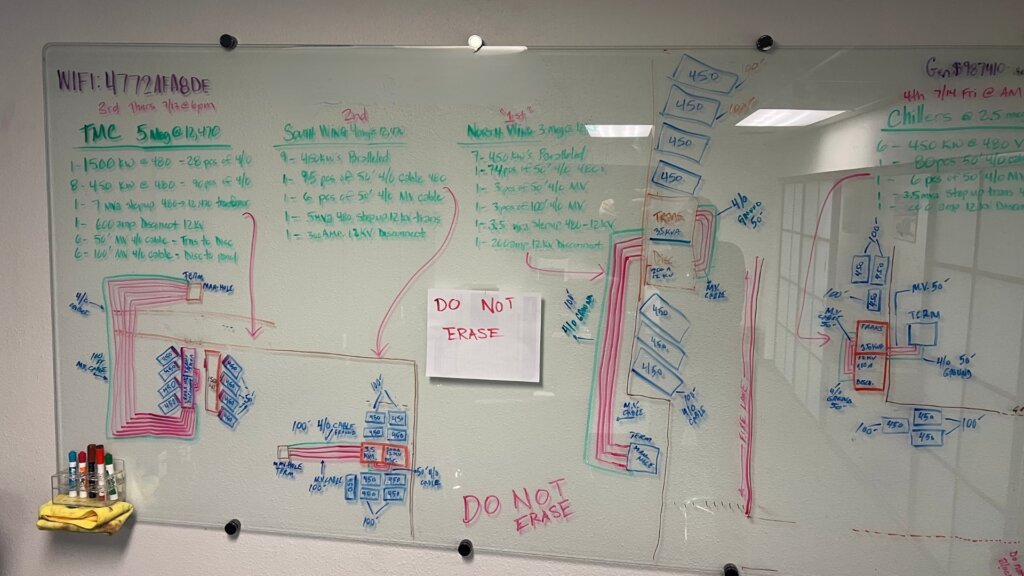
* Where it all began. Power Plus teams came together to sketch out initial concepts and lay the groundwork for the hospital’s temporary power plan.
Testing the Hospital Generator Rental Before the Outage
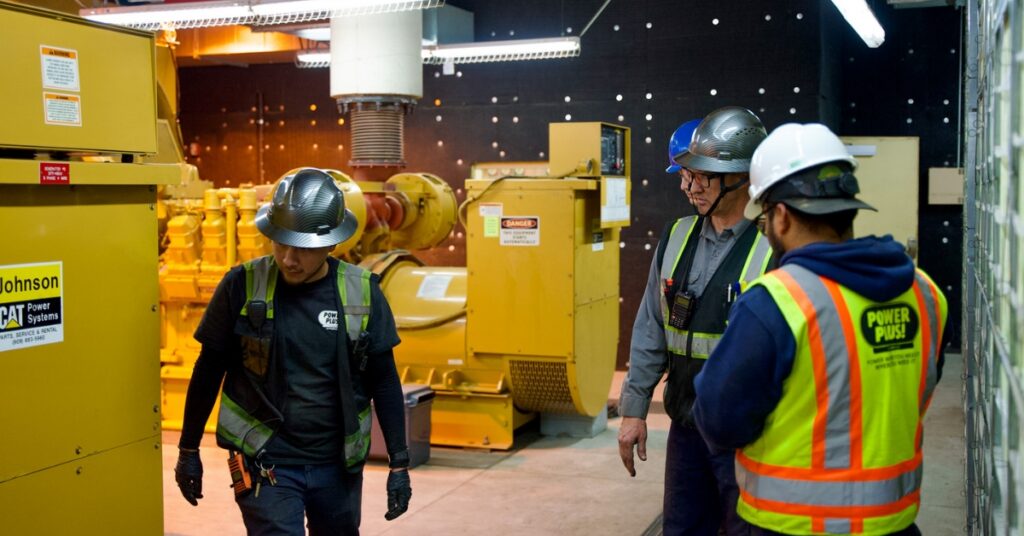
Power Plus set up on site a full two weeks before the shutdown. The fleet combined 1.5 megawatt generators paralleled alongside (8) – 500kW units, all wired up to the 1500kVA transformer and dry tested to confirm the full 6.5 megawatts, with every generator in line, communicating, and paralleling correctly. By the night of the shutdown, every unit was tested, proven, and ready.
The Flicker
Late on a Thursday night, around eleven o’clock, with no fewer than 34 support personnel onsite, the main breaker opened and this Level 1 Trauma Center transferred from utility power to Power Plus generators. Someone said a quick prayer. The lights of the building, which glows at night like a five star hotel, flicker for a single moment and then hold steady. If you missed the flicker, you would never know anything had happened.
That was the point.
For the next two days, through Sunday morning, the entire hospital ran on Power Plus power. Both operations managers were personally on site for the connection, throughout the outage, and for the transfer back. A fuel truck stayed parked on the grounds, and the operation burned roughly 13,000 gallons of fuel keeping the generators running around the clock. Three technicians stood by at all hours, two from the portable power side, one from service and maintenance, alongside paralleling specialists watching over the fleet.
While there were no major failures of the equipment, the hospital loads did fluctuate somewhat. Because of the redundancy built into the design, the rest of the fleet carried the load without interruption. And the people inside the hospital never knew there was a major surgery underway on the building’s electrical infrastructure.
Inside the hospital, things proceeded normally. Seven babies were born during the outage. Emergencies came through the doors and were treated. Surgeries proceeded as scheduled. The hospital’s own emergency generators sat ready as a final layer of protection, but they were never needed. For the patients, the families, the doctors, and the nurses, it was simply business as usual. That was the entire mission, and it was accomplished completely.
The Transfer Back
Restoring utility power was every bit as disciplined as dropping it. The teams worked from a signed-off “Method Of Procedure”, a formal step by step document that Power Plus, Hampton Tedder, the facility team, and the utility all verified together. Phase rotation confirmed. Voltage verified. Breakers opened and closed in exact sequence, with every step called out over walkie talkies and signed off before the next one began. Early Sunday morning, utility power flowed back into the facility, the generators wound down, and the largest trauma center in Southern California had passed through a first in its history without a single missed heartbeat of operations.
More Than a Job
For the Power Plus team, this hospital and its staff are not just another client on a generator service schedule.
One of the Power Plus operations leaders had donated a kidney to his niece at this very hospital sixteen years ago. Another employee watched his young grandson fight a rare illness in the pediatric wing, where the leading specialist in the country on that disease happened to be on hand and turned fear into a treatment plan that sent the boy home healthy. During that hospital stay, the little boy heard beeping outside his window late one night, called his mother over to see the truck, and looked down at a Power Plus crew responding to an emergency on one of the hospital’s generators.
The Power Plus Difference
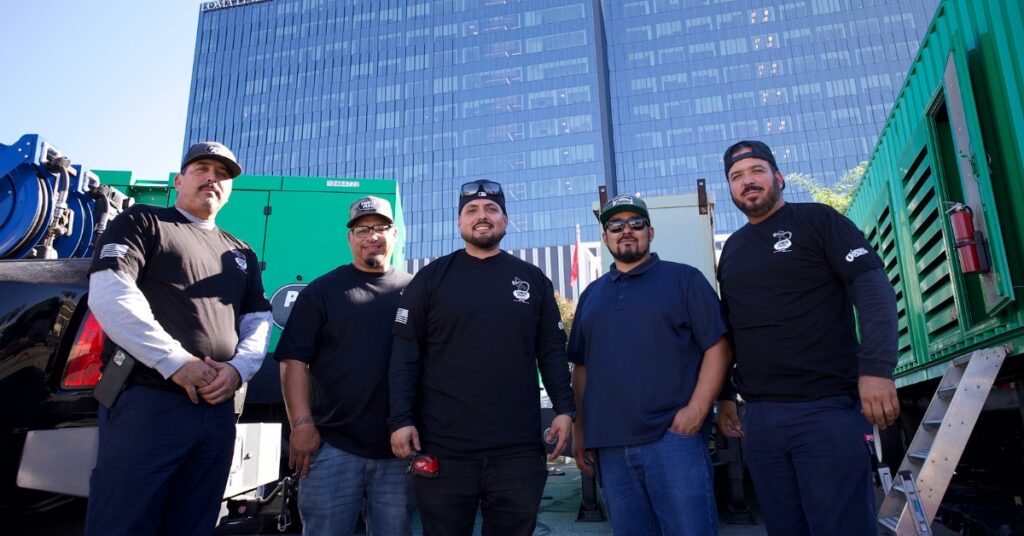
This project asked for everything a power solutions company can offer. Fifteen years of earned trust. The engineering depth to plan a 6.5 megawatt paralleled temporary power plant at 12 kV. The honesty to bring in a specialist for the one connection that demanded it. The discipline of two weeks of dry testing. The grit of two operations managers up all night solving failures before they could ever reach the customer. And the humanity to treat a hospital full of strangers like family.
The utility shut off the power. The hospital never went dark. And somewhere inside, families welcomed new babies without ever knowing the building beneath them was running on generators in the parking lot. That is what it means to be a power partner.
Planning an electrical shutdown at a hospital or healthcare facility? Power Plus provides industrial generator rentals and temporary power planning for facilities that need to stay operational during utility work, equipment upgrades, and planned outages. Talk with our team about your load requirements, connection, testing schedule, and on-site support.