



Hospital Emergency Power: A Vendor Readiness Framework
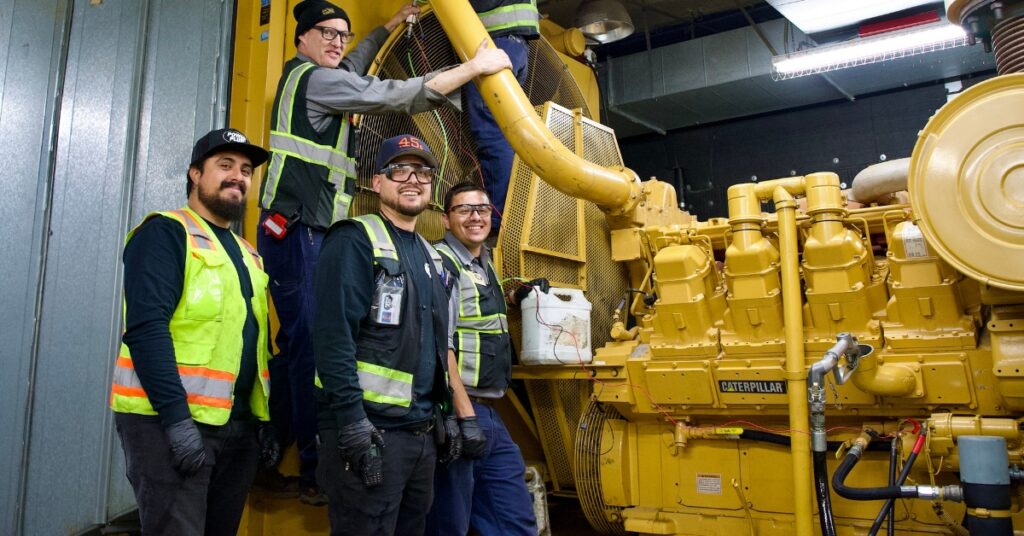
Hospital emergency power is engineered for redundancy at every layer — separate life safety and critical branches, ten-second transfer, and a dedicated hospital backup generator standing behind it all. Yet nearly every healthcare facility hands the maintenance of that entire system to a single service vendor, and that relationship is almost never examined with the rigor applied to the equipment it protects.
This paper introduces the Vendor Readiness Framework: five capabilities that determine whether your backup generator maintenance partner is reducing your facility’s risk, or quietly adding to it. It then tests those capabilities against the three situations where the difference becomes visible: the accreditation survey, the planned shutdown, and the middle-of-the-night failure.
Hospital Power Can Be Compliant, Documented, and Still Exposed
Walk into the electrical room of any acute-care hospital and you are standing inside one of the most deliberately engineered redundancy schemes in any industry. NFPA 99 divides the essential electrical system into separate branches — life safety, critical, and equipment so that no single fault can darken the spaces where failure means harm. Transfer switches stand ready to move load in ten seconds or less. A Level 1 backup generator waits behind them, sized, tested, and dedicated to the assumption that one day the utility will fail at the worst possible moment.
Every element of that design exists to eliminate single points of failure. However in most hospitals, the maintenance of that entire system — the generator, the transfer switches, the fuel, the batteries, the records that prove all of it works is placed in the hands of a single service organization, selected years ago, evaluated mostly on price and familiarity, and rarely examined since.
Here’s Why The Single Point of Failure in Hospital Emergency Power Isn’t the Equipment. The equipment has redundancy. The vendor relationship has none.
Healthcare carries a second exposure that other critical facilities do not. In a data center, a generator either performs or it doesn’t. In a hospital, the generator’s performance and the record of its performance are both regulated.
This paper offers a structured way to examine that overlooked layer. The premise is simple enough to state in two sentences, and the rest of this paper is an argument for taking them seriously: Infrastructure redundancy protects against equipment failure. Vendor readiness protects against execution failure.
The question underneath the service contract
Ask a facilities director whether their generator vendor is good, and the honest answer is usually some version of: they show up, the tests pass, the price is fair. That answer describes a vendor who completes work. It says nothing about whether the vendor reduces risk.
The distinction matters because the moments that define a hospital’s power reliability are precisely the moments a routine service visit never touches. The surveyor who asks for fourteen months of records. The alternator that has to come out of a building that cannot lose its critical branch for even a minute. The failure at 2 a.m. on a holiday weekend, with a part the manufacturer discontinued six years ago.
The Vendor Readiness Framework evaluates a service partner across five capabilities. Each is stated the same way for every industry we serve, because the framework is the constant; what changes is where each capability gets tested. In healthcare, they read as follows.
1. Technical Depth
Understanding the facility as a complete power system — multi-OEM capability and diagnostics that go beyond routine preventive maintenance.
A hospital’s emergency power is not a generator. It is a system: the generator, a population of automatic transfer switches distributed across three branches, paralleling gear in larger plants, day tanks and fuel systems, and the load behavior of a building where motors, imaging equipment, and life-safety systems all demand power in a specific sequence within ten seconds. Technical depth means the vendor’s technicians understand branch separation and load pickup verification — not just engine mechanics. It also means competence across manufacturers.
2. Response Capability
A qualified person who can assess, escalate, mobilize, and communicate at any hour — not a phone number.
Every vendor advertises 24/7 emergency service. The claim worth testing is what happens after the phone is answered. In a life-safety occupancy there is no acceptable version of “we can have someone there Monday.” Response capability is measured in the distance between the call and a qualified technician standing in your electrical room with the authority to act and in whether the person coordinating that response can speak to your situation in your terms: which branches are exposed, what the load picture looks like, what gets mobilized if the first fix fails.
3. Fleet Support
Restoring lost redundancy margin through appropriately sized, correctly configured temporary power.
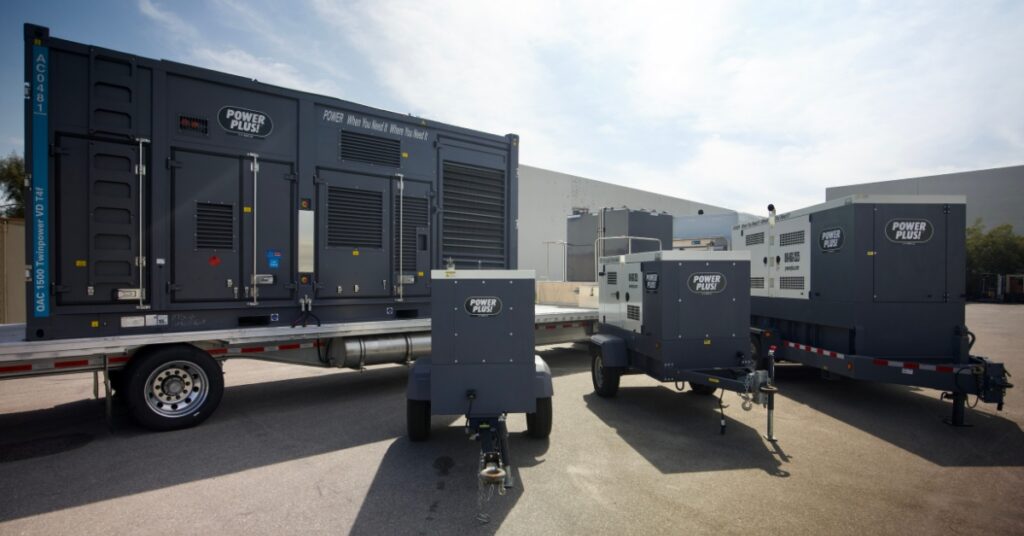
The essential electrical system is designed on the assumption that the generator is available. The moment a major component comes out for service — an alternator, a transfer switch, the generator itself — that assumption is suspended, and the facility is running with less protection than its design intends. Fleet support is the capability that closes the gap: temporary generation, sized for the actual load, connected at the right point in the distribution, capable of holding the life safety and critical branches for as long as the work takes. A vendor without meaningful access to a commercial generator rental fleet can maintain your equipment. They cannot maintain your margin.
4. Parts Independence
Sourcing through multiple channels and manufacturers rather than a single OEM supply chain.
Hospital generators are long-lived assets in buildings that cannot schedule extended downtime, which produces a predictable collision: aging equipment, discontinued components, and a facility that cannot simply wait. When a controller fails on a twenty-year-old unit, the question that determines your exposure is not how fast the fault is diagnosed — diagnosis is usually quick. It is how many channels the vendor can work to produce the part: OEM stock, aftermarket sources, salvage, or a compatible substitution engineered on the spot. A vendor locked to one manufacturer’s supply chain has exactly one answer, and it is often a lead time.
5. Operational Transparency
Turning field activity into operational evidence through documented, trended, integrated reporting. In most industries, a service report is a receipt — proof that work happened, filed and forgotten. In healthcare it is something else entirely, and this is the capability the rest of this paper turns on. In a hospital, the service record is not a receipt. It is evidence in a regulatory proceeding.
A vendor whose work is excellent but whose documentation is thin has not reduced your risk. They have transferred it to you, and you will discover the transfer at the worst possible moment, standing next to a surveyor.
Three situations that reveal what your vendor actually is
Capabilities are abstractions until something tests them. In healthcare, three situations do the testing and none of them can be improvised.
Situation one: the survey
The scenario every facilities director already knows. Surveyors arrive, often unannounced, and the emergency power portion of the visit is a document review before it is anything else. The generator’s mechanical condition matters, but the questions come at the file: show me the monthly tests. Show me the intervals. Show me the load values. Show me what you found in October and what you did about it.
In that room, your vendor’s documentation practices are your compliance posture. A facility served by a transparency-strong vendor hands over a complete, organized, internally consistent record and the conversation moves on. A facility served by a checkbox vendor spends the next several weeks reconstructing evidence for work that may well have been performed perfectly — and reconstruction, visible as such, invites exactly the deeper scrutiny everyone hoped to avoid.
The time to find out which facility you are is not during the survey. It is now, by asking your vendor to produce the file today and reading it the way a surveyor would.
Situation two: planned work on a system that is never allowed to stop
Sooner or later, every hospital faces major work on its power infrastructure: an alternator replacement, a transfer switch changeout, switchgear service, or a utility-side shutdown that takes normal power away from the entire campus. In any other building type, the answer is simple — schedule an outage. A hospital does not have that answer. Surgeries are scheduled, the emergency department is open, and running on the facility’s own emergency generators for the duration is not a neutral choice: under emergency power, most hospitals operate in a restricted posture, which can mean diverted ambulances and postponed procedures. For the surrounding community, the hospital being “on backup” is itself a degraded state.
This is the situation where fleet support and technical depth stop being line items and become the plan. Executed well, it looks like this: temporary generation sized above the calculated requirement — deliberately, because the plan needs margin the same way the building does. Connection points engineered in advance, at the right place in the distribution, coordinated with the branches that can never drop. Equipment staged and dry tested on site for days or weeks before the shutdown, because temporary plants have infant failures and the time to find them is before the building depends on them. A written MOP governing every switching step, verified by the facility, the vendor, any specialists, and the utility. Fuel logistics planned for the full duration. Technicians on site around the clock while the temporary plant carries the load.
Done to that standard, the defining feature of the event is that almost no one inside the building knows it happened. Care proceeds. The lights hold. The hospital’s own emergency generators sit as the final layer of protection and are never needed.
Done to a lesser standard, the same event becomes the story the facilities team tells for years, and not fondly.
The evaluation question is direct: has your vendor actually executed this at hospital scale, at medium voltage if your campus requires it, under a signed MOP or would your facility be their first?
Situation three: the 2 a.m. failure
The unplanned version arrives without a planning window. An alarm, a failed start, a transfer switch that didn’t. Now three capabilities are tested at once, in sequence: response capability determines how fast a qualified person is in the room. Technical depth determines whether the diagnosis is right the first time, on your manufacturer, at your vintage. And parts independence usually determines the length of the exposure — because in our experience the diagnosis comes first and the component takes the time it takes, unless the vendor can work more than one sourcing channel at once.
The healthcare-specific pressure is that the exposure window is intolerable in a way it is not elsewhere. A retail building down for a day is a business problem. A hospital with a compromised essential electrical system is operating outside its design basis with patients inside it. The vendor question is therefore not “do you offer emergency service” — everyone does — but what have you actually restored, how fast, and what did you do when the first plan failed? Vendors with real emergency depth have those stories and the records behind them. Vendors without it have a phone number.
Qualify the relationship while the lights are on
Everything in this paper reduces to a single discipline: examine the service layer with the same rigor the building’s designers applied to the electrical one. The essential electrical system exists because someone refused to accept a single point of failure between the utility and a patient. The vendor relationship deserves the same refusal.
The qualification conversation costs an afternoon. Have it now while the building is running normally, while the questions are hypothetical, while a weak answer is merely useful information instead of an active emergency. The worst possible moments to discover a vendor gap are the three this paper describes, and by then the discovery is not an evaluation. It is an event.
Infrastructure redundancy protects against equipment failure. Vendor readiness protects against execution failure.
Frequently asked questions
What does NFPA 99 require for hospital generator testing?
NFPA 99 classifies hospital essential electrical systems as Type 1 and points to NFPA 110 for the testing regime: weekly inspections, monthly load tests at a minimum of 30 percent of nameplate rating conducted twelve times per year at 20-to-40-day intervals, monthly transfer switch exercising, and longer-interval load bank requirements. Records must be maintained and available to the authority having jurisdiction.
How do hospitals keep power on during major electrical work?
With temporary generation planned in advance: rental units sized above the calculated load, connected at engineered points in the distribution, dry tested on site before the work begins, and governed by a written method of procedure signed by every party. Done properly, the life safety and critical branches never see an interruption, the facility’s own emergency generators remain untouched as the final layer of protection, and clinical operations proceed normally for the duration.
Do we need a second power vendor if we already have one we trust?
Not necessarily — but you need your vendor relationship to be examined with the same rigor as the equipment it maintains. The essential electrical system eliminates single points of failure by design; a single unexamined service relationship reintroduces one. For some facilities the answer is a qualified second provider for defined capabilities like temporary power or emergency response. For others it is holding the incumbent to the five capabilities in this framework and scoring the evidence honestly. Either way, the qualification conversation should happen while the building is running normally — not during a survey, and not at 2 a.m.